
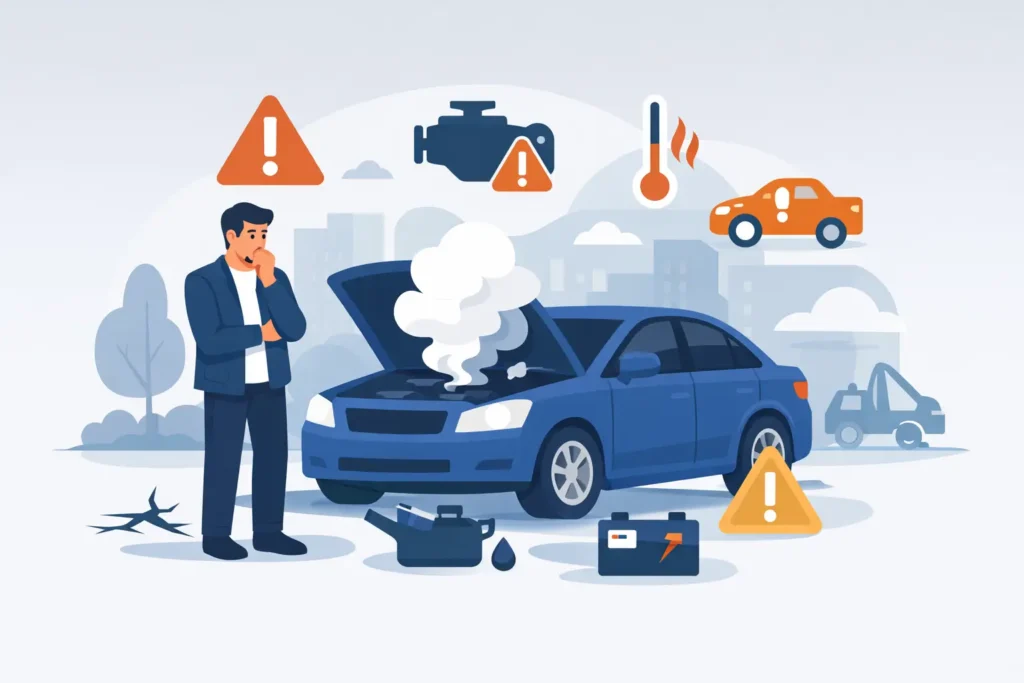
That faint burning smell on I-45, a dashboard light that just appeared, or an engine that suddenly feels rough can turn a normal drive into a roadside emergency fast. Knowing the car breakdown warning signs gives you time to pull over safely, avoid greater damage, and arrange help before your vehicle leaves you stranded in traffic.
For drivers in Spring, The Woodlands, Oak Ridge North, Shenandoah, and Conroe, the right response depends on the symptom. Some issues can wait for a repair appointment. Others mean you should stop driving immediately and call for roadside assistance or a tow.
Car Breakdown Warning Signs That Need Fast Action
1. Your temperature gauge is in the red
An overheating engine is one of the clearest signs to stop. Steam from under the hood, a hot or sweet coolant smell, or a temperature gauge climbing into the red can mean low coolant, a leaking hose, a failed radiator fan, or another cooling-system problem.
Pull over as soon as it is safe, turn off the engine, and let it cool. Do not open the radiator cap while the engine is hot. Pressurized coolant can cause serious burns. If the vehicle overheated, a flatbed tow is often the safest choice rather than attempting to drive it farther.
2. The oil pressure light comes on
The red oil light is not a reminder to check your oil next week. It can mean the engine is not receiving enough oil pressure, which can cause severe internal damage within minutes. You may also hear ticking, knocking, or grinding from the engine.
Safely pull over and shut the engine off. Checking the dipstick after the engine has cooled may show low oil, but adding oil does not always solve the underlying issue. A leak, failed oil pump, or internal engine problem needs professional attention.
3. You see smoke or smell something burning
Smoke is never a symptom to ignore. White steam may point to an overheating cooling system, while blue-gray smoke from the exhaust can signal oil burning inside the engine. Thick black exhaust smoke can mean too much fuel is being burned.
A burning rubber smell may come from a slipping belt or tire issue. A sharp electrical smell can indicate damaged wiring. If smoke is coming from the engine bay or beneath the vehicle, pull over, turn the vehicle off, move away from traffic, and request help. If there is visible fire, get away from the vehicle and call 911.
4. The battery light stays on while you drive
A battery warning light often means the charging system is failing, not simply that the battery is old. The alternator, belt, wiring, or battery connections could be the problem. Your vehicle may continue running briefly, then lose electrical power as the battery drains.
Watch for dim headlights, flickering interior lights, warning messages, or power steering that becomes harder to use. Do not assume a jump start will fix an alternator issue. If the light remains on after starting, plan to get the vehicle checked or towed.
5. Brakes feel soft, pull, grind, or shake
Brake trouble demands immediate attention because it affects your ability to stop. A soft or spongy brake pedal may indicate low brake fluid or air in the lines. Grinding can mean worn brake pads or damage to brake components. Vibration when braking, a vehicle that pulls to one side, or a pedal that sinks toward the floor are also serious warnings.
Slow down, increase your following distance, and pull over safely. Avoid driving through busy traffic or continuing at highway speed. A tow is the safer call when braking performance has changed.
6. Steering suddenly feels heavy or loose
If your steering wheel becomes difficult to turn, the vehicle drifts, or the steering feels unusually loose, do not keep driving and hope it improves. Low power steering fluid, a broken belt, suspension damage, or a steering-system fault can make the vehicle hard to control.
This is especially risky on wet roads, curves, and high-speed routes around South Montgomery County. Stop in a safe place and arrange transport rather than taking chances with control of the vehicle.
7. You hear knocking, grinding, squealing, or repeated clicking
Not every sound means an immediate breakdown, but a new, loud, or worsening noise should be taken seriously. Engine knocking may point to internal engine damage. Grinding while driving can come from brakes, wheel bearings, or drivetrain parts. A high-pitched squeal may be a worn belt, while rapid clicking when you turn the key often points to a weak battery or starter issue.
The key question is whether the sound comes with other symptoms: warning lights, vibration, loss of power, smoke, or trouble steering or braking. When it does, stop driving. If the vehicle is operating normally but the sound is new, schedule an inspection soon before a smaller repair becomes a roadside problem.
8. Your vehicle shakes, vibrates, or pulls at speed
A mild vibration might be an unbalanced tire, but strong shaking is not something to test at higher speeds. It can be caused by a damaged tire, loose wheel lug nuts, a bent wheel, brake problems, suspension wear, or drivetrain trouble.
If you feel a sudden thump followed by vibration, treat it like a possible tire failure. Ease off the accelerator, hold the steering wheel firmly, avoid hard braking, and move to a safe shoulder or parking area. Do not drive on a flat tire, even for a short distance. It can ruin the tire and wheel and create a much more expensive repair.
9. You have a flashing check engine light
A steady check engine light should be diagnosed soon, but a flashing check engine light is more urgent. It often indicates an engine misfire that can damage the catalytic converter if you continue driving.
You may feel the engine shaking, hesitating, or losing power. Reduce speed, avoid heavy acceleration, and pull over if the condition is severe. A vehicle that is misfiring badly may need a tow instead of a drive to the repair shop.
10. Fluid is leaking under the vehicle
A small amount of clear water under the vehicle may simply be air-conditioning condensation. Other fluids deserve a closer look. Bright green, orange, pink, or yellow fluid can be coolant. Dark brown or black fluid may be engine oil. Red or reddish-brown fluid may be transmission or power steering fluid.
Fresh fluid on your driveway is a reason to schedule service. A large puddle, a fast drip, or a leak paired with an overheating light, warning light, or poor shifting means stop driving. Low fluid levels can quickly damage an engine or transmission.
11. The engine stalls, loses power, or will not restart
An engine that stalls at a stoplight, loses power while accelerating, or cranks without starting may have a fuel, ignition, battery, sensor, or mechanical issue. Repeatedly trying to start it can drain the battery and may not solve anything.
If you are stalled in traffic, turn on your hazard lights and move out of the traffic lane only if it can be done safely. If the vehicle will not restart, do not remain in an unsafe location trying to diagnose it. Call a local towing professional for help or safe transport.
12. A tire is flat, damaged, or losing air quickly
A flat tire is one of the most common breakdowns, but it still requires a careful decision. A spare tire can help if you are parked safely, have the right tools, and know the tire is safe to install. On a narrow shoulder, in heavy traffic, during rain, or at night, changing a tire yourself can put you in danger.
Sidewall damage, a bulge, deep crack, or shredded tread means the tire should not be driven on. Call for a tire change or tow, particularly if you are near a busy road or your vehicle does not have a usable spare.
What to Do When Warning Signs Appear
Your first priority is not saving time. It is getting yourself, your passengers, and other drivers out of danger. Turn on your hazard lights, reduce speed smoothly, and pull into a parking lot, wide shoulder, or other safe location when possible. Avoid stopping on a curve, near the crest of a hill, or in an active traffic lane.
Once stopped, do not stand near moving traffic. Keep doors locked if you are in an unfamiliar area, and stay inside the vehicle when it is safer than walking along the roadway. If you need help in South Montgomery County, Local Tow Truck can provide towing, flatbed transport, jump starts, tire changes, and lockout assistance with direct local response.
When you call for help, share your location, vehicle make and model, what warning lights are on, and whether the vehicle can move safely. Those details help the dispatcher send the right equipment and prepare for the situation.
A warning light or strange sound may feel inconvenient when you are trying to get to work, pick up kids, or make an appointment. Pulling over early is usually the decision that keeps a manageable repair from becoming a dangerous breakdown.


