
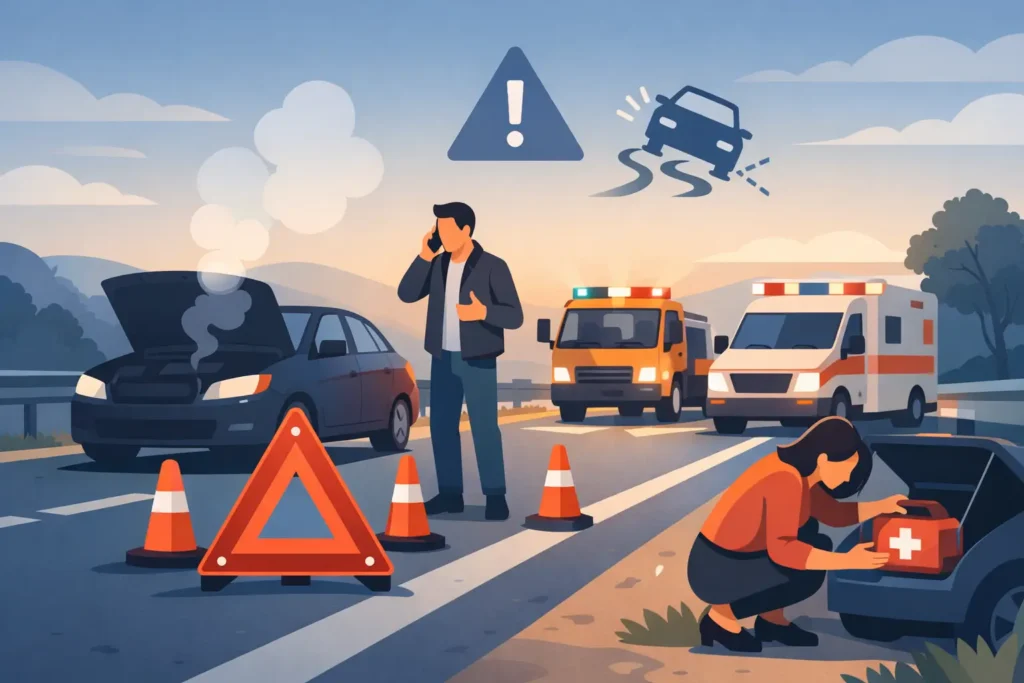
A dead battery on I-45 at night feels different than a flat tire in a grocery store lot. One gives you room to think. The other puts traffic, weather, and nerves on top of the problem. This roadside emergency safety guide is built for drivers in South Montgomery County who need a clear plan fast – not a lecture, not a checklist you will forget, just the right steps in the right order.
What to do first in a roadside emergency
Your first job is not fixing the car. Your first job is staying out of the path of traffic.
If the vehicle is still moving, ease off the road as far as you safely can. A wide shoulder, parking lot entrance, side street, or well-lit business frontage is better than stopping in a travel lane. Turn on your hazard lights immediately, even before you come to a full stop if needed. In places like Spring, The Woodlands, Shenandoah, and Conroe, traffic can stay fast even when roads look calm.
Once stopped, take a breath and look at your surroundings. If you are close to moving traffic, on a narrow shoulder, near a curve, or on a bridge, treat the scene as unsafe. In those cases, staying inside the vehicle with your seat belt on is often the safer move. If you are in a safer location away from traffic, you may be able to step out carefully on the side away from the road.
The details matter here. A minor breakdown becomes dangerous when a driver gets out too quickly, stands near traffic, or tries to inspect the vehicle in a blind spot.
When to stay in the car and when to get out
This is where a good roadside emergency safety guide needs some honesty. There is no one rule for every breakdown. It depends on where you are stopped.
If you are on the shoulder of a busy highway, especially at night or in rain, stay in the vehicle unless there is smoke, fire, or another immediate hazard. Keep your seat belt on. Call for help. Let professionals handle the roadside side of the job.
If you are in a parking lot, neighborhood street, or wide shoulder with plenty of separation from traffic, it may be reasonable to exit the vehicle from the passenger side and move to a safer area away from the road. Take passengers with you if doing so is safer than leaving them inside.
Never stand between your vehicle and passing traffic. Never crouch near the driver-side tires if vehicles are flying by a few feet away. A flat tire is inconvenient. A close call with traffic is not worth it.
If the car is smoking or you smell fuel
Move away from the vehicle and keep others back. Do not open the hood if you suspect fire. Do not try to restart the car repeatedly. Call for emergency help first if there is fire risk, then arrange towing.
Make your vehicle visible
Visibility buys you time. It also gives other drivers a chance to move over.
Hazard lights should stay on as long as the vehicle is disabled. If you have reflective triangles or flares and the area is safe enough to place them, use them. On a fast road, place warning devices well behind the vehicle so oncoming drivers get early notice. If conditions are too dangerous to walk around outside the vehicle, skip the triangles and stay inside.
At night, keep the interior light use minimal if it makes it harder for you to see outside. If your battery is weak, you may need to conserve power. That said, hazards usually remain the top priority because being seen matters more than saving every bit of charge.
Bad weather changes the equation. Heavy rain, fog, and glare can make your stopped vehicle almost invisible until the last second. In those moments, location matters more than repair. Getting farther off the road is often the best move if the car can still roll safely.
Call for help with the right information
When you need roadside assistance, speed matters. So does accuracy. The fastest way to get help is to tell the towing professional exactly where you are and what the vehicle is doing.
Start with your location. Use road names, mile markers, nearby exits, business names, or what direction you were traveling. Saying “I am on I-45 northbound near Rayford” is much more useful than saying “I am by The Woodlands.” If you are in a neighborhood or shopping area, give the closest cross street.
Then explain the problem in plain language. The car will not start. The front passenger tire is flat. The keys are locked in the car. The steering feels broken. It is on the shoulder and cannot move. Those details help dispatch the right service the first time.
If you are in South Montgomery County and need quick local help, talking directly to a nearby towing professional is often better than waiting through a distant call center script. Local roads, traffic patterns, and landmarks make a difference when minutes count.
Common roadside problems and the safest response
Some problems look simple but are not always safe to handle on the roadside.
A dead battery is usually one of the lower-risk situations if you are parked somewhere safe. A jump start may solve the problem quickly. But if the battery died in an unsafe spot, the priority is still location and visibility, not opening the hood right away.
A flat tire is where many drivers get hurt. Changing a tire on a quiet driveway is one thing. Changing one inches from highway traffic is another. If you are not well off the road on level ground, do not try it. Call for help and wait in the safest place available.
A lockout can feel urgent, especially in Texas heat. If a child, older adult, or pet is inside the vehicle, call 911 right away. That is an emergency. If no one is in danger, stay calm and request lockout service.
Mechanical failure, overheating, steering issues, or brake trouble usually mean the vehicle should not be driven farther. Trying to limp it to the next exit can turn a repair into a major breakdown or crash.
What to keep in your vehicle
You do not need a mobile workshop in your trunk, but a few items help. Keep a phone charger, flashlight, bottled water, reflective triangles, basic first aid supplies, and your insurance and registration easy to reach. A small towel and work gloves can help too. In summer, water matters more than people think. In storm season, a charged phone matters even more.
Protect passengers while you wait
If children are with you, keep them buckled unless you have moved everyone to a clearly safer spot away from traffic. Do not let anyone wander near the road shoulder. If weather is extreme, monitor the cabin temperature and decide whether staying in the vehicle or moving to a nearby safe building makes more sense.
For older drivers or anyone with medical concerns, mention that when you call for help. Heat, stress, and roadside noise can make a manageable breakdown feel much worse. If someone is in distress, get emergency medical help first.
Pets add another variable. A frightened dog can bolt into traffic the second a door opens. Keep pets restrained and do not remove them from the vehicle unless you have a secure safe place to stand away from the road.
Roadside emergency safety guide for South Montgomery County drivers
Local roads create local risks. On I-45, speed is the issue. On feeder roads, drivers may drift closer to the shoulder than expected. In shopping corridors around Shenandoah and The Woodlands, sudden lane changes and distracted driving are common. In less developed stretches near Conroe, lighting can be poor at night.
That means the safest response is not always the same. On a bright commercial street, walking to a nearby parking lot may be fine. On a dark highway shoulder, staying belted inside the vehicle may be the better call. If your car is disabled in Spring, Oak Ridge North, or anywhere nearby, think first about traffic exposure, then visibility, then service.
A trusted local towing service should be able to give you a realistic ETA and understand your area without making you explain every landmark twice. That kind of response lowers stress fast because you know help is actually on the way.
What not to do
Do not stand behind or directly in front of a disabled vehicle on the roadside. Do not accept help from random passing motorists if the situation feels off. Do not walk along a busy highway shoulder to find assistance. Do not try to push the vehicle unless conditions are clearly safe and you have enough help to do it without entering traffic.
And do not let embarrassment rush your choices. A lot of drivers make bad decisions because they want to clear the scene quickly. Fast matters, but safe matters first.
If you ever need a tow, jump start, tire change, or lockout help in this area, the smartest move is simple: get yourself visible, get yourself safe, and call a pro who can reach you fast. A calm response in the first few minutes does more to protect you than any tool in the trunk.


